← PortfolioLINKUPIndependent PlayStation UX concept Open prototype ↗
sony.pngplaystation.png
PORTFOLIO / SIE
INDEPENDENT PRODUCT DESIGN CONCEPT
LINKUP
A clearer path from wanting to play to playing together.
Play with purpose.
Find the right game and people for the
time, mood, and social experience you
have right now.
RESEARCH / INTERACTION / VISUAL DESIGN
An end-to-end UX case study tailored to Sony
Interactive Entertainment and the PlayStation
ecosystem.
screen_0.png
screen_2.png
LINKUP / Independent concept for Sony Interactive Entertainment
01
sony.pngplaystation.png
PORTFOLIO / SIE
THE PLAYERS / PROBLEM AND NEED
Three situations. One need to start playing.
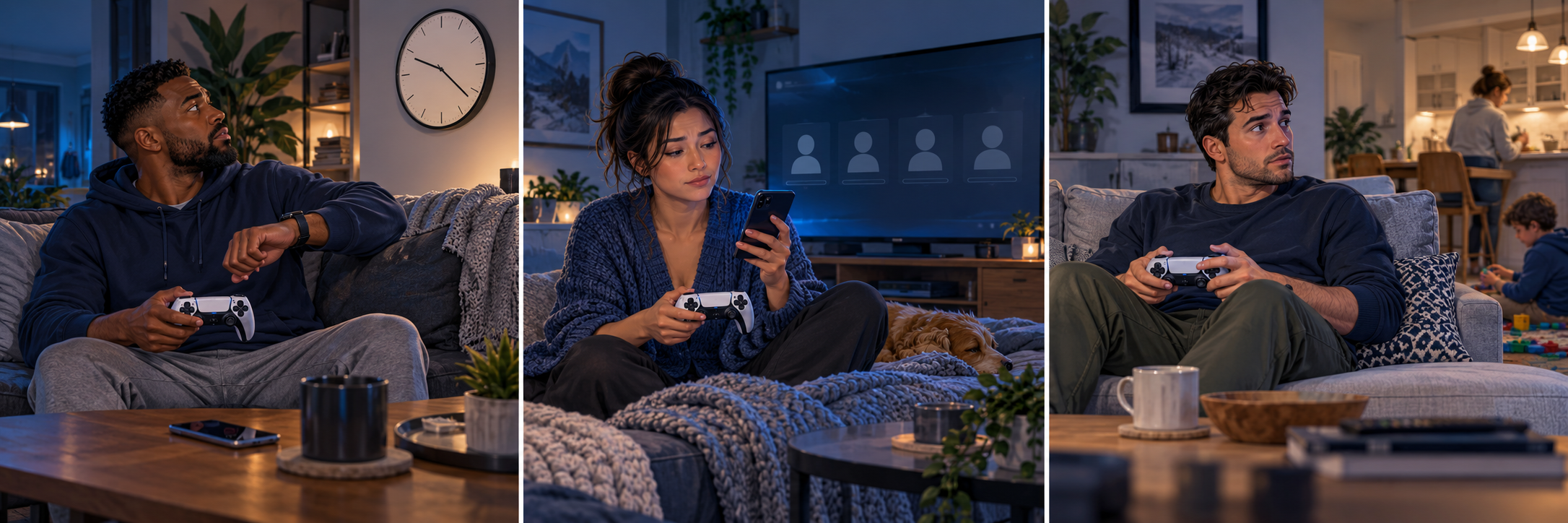
Illustrative composite personas show why choosing a game and a group can take more effort than playing.
FICTIONAL PERSONAS / AI-generated scenario illustrations. These are not research participants.
persona_scenarios.png
Marcus
A short window to play
PROBLEM
Coordination is consuming his available
play time.
NEED
See who is ready and judge session length
quickly.
Danielle
Friends are offline tonight
PROBLEM
A new group feels uncertain when its
expectations are unclear.
NEED
Understand play style and the group before
joining.
Chris
Co-op without a microphone
PROBLEM
Voice expectations make joining feel
uncomfortable.
NEED
Know voice is optional and that quiet play is
welcome.
LINKUP / Independent concept for Sony Interactive Entertainment
02
sony.pngplaystation.png
PORTFOLIO / SIE
01 / THE TASK
Make starting a session feel easy.
The problem is the effort between “I want to play” and a session that actually fits.
How might we help players quickly find the
right game and the right people for the
amount of time, mood, and social
experience they want right now?
Project scope
Independent app concept.
Covers discovery, fit, joining, party
invitations, console handoff, and
recovery.
Final output: a clickable high-fidelity
prototype, with tablet and desktop
explorations.
Contribution shown
Problem framing, persona development, simulated research synthesis,
wireframes, UI foundations, interaction design, and evaluation planning.
LINKUP / Independent concept for Sony Interactive Entertainment
03
sony.pngplaystation.png
PORTFOLIO / SIE
02 / THE DESIGN PROCESS
A traceable path from question to product.
Each stage connects a player need to a design decision and a visible artifact.
01
Frame
Task, constraints, assumptions
PAGES 05-07
02
Explore
Synthetic interviews and themes
PAGES 08-09
03
Structure
Journey, flow, sketches
PAGES 10-11
04
Iterate
Wireframes and simulated studies
PAGES 12-14
05
Design
UI system and final interactions
PAGES 15-21
06
Evaluate
High-fidelity simulation and next
steps
PAGES 22-26
LINKUP / Independent concept for Sony Interactive Entertainment
04
sony.pngplaystation.png
PORTFOLIO / SIE
03 / RESEARCH PLAN
Start with coordination, not feature demand.
Research question: what prevents players from starting the session they actually want?
Working assumptions
Coordination consumes short play
windows.
Mood changes the experience
people want.
Availability does not guarantee
compatibility.
Trust and safety can limit
openness to new people.
Exploration plan
Compare current behavior across
friends, solo play, and new groups.
Probe game choice, time available,
voice expectations, and
workarounds.
Use synthetic interviews to develop
hypotheses for later real research.
What could disprove it?
Existing friends, Discord, and
in-game matchmaking may already
solve the problem well.
A new tool must reduce effort rather
than duplicate those habits.
The concept does not establish
unmet demand.
LINKUP / Independent concept for Sony Interactive Entertainment
05
sony.pngplaystation.png
PORTFOLIO / SIE
04 / INITIAL PROTO-PERSONAS
Three starting hypotheses.
Behavioral profiles guide questions; they are not demographic segments validated by research.
SIMULATED RESEARCH / Fictional participants and assigned outcomes. No real study data.
Time-Boxed Player
Goal: play within a 20-60 minute
window.
Friction: too many choices,
unavailable friends, and setup time.
Design need: quick entry and clear
session expectations.
Risk: overestimating coordination
friction.
Social Regular
Goal: play with a known group.
Friction: scheduling, game
consensus, and fragmented tools.
Design need: know who is ready
and agree on a game.
Risk: assuming interest in strangers.
Open Explorer
Goal: join a compatible new group.
Friction: toxicity, skill mismatch, and
unclear voice norms.
Design need: understand the room
before joining.
Risk: prioritizing discovery over
safety.
LINKUP / Independent concept for Sony Interactive Entertainment
06
sony.pngplaystation.png
PORTFOLIO / SIE
05 / PERSONA REFINEMENT
Time is a context, not a fixed identity.
The synthetic synthesis changed the model before the interface was finalized.
SIMULATED RESEARCH / Fictional participants and assigned outcomes. No real study data.
CONTEXT OVERLAY
Time available + mood + friends available + voice preference
Social Regular
Familiar people first. A player may wait for friends
on a weekend, then choose a quick solo or open
session on a weeknight.
Open Explorer
New people when expectations fit. Clear play style
and optional voice support a situational choice,
rather than a permanent player label.
DESIGN CONSEQUENCE
Ask for intent now; avoid locking people into a persona.
LINKUP / Independent concept for Sony Interactive Entertainment
07
sony.pngplaystation.png
PORTFOLIO / SIE
06 / SYNTHETIC INTERVIEW DATA
Eight scenarios made the assumptions concrete.
The records below are invented interview summaries used to explore possible patterns.
SIMULATED RESEARCH / Fictional participants and assigned outcomes. No real study data.
ID / hypothesis
Imagined behavior or friction
Design implication
I01 / time-limited
Library + group chat, then solo fallback
Reduce coordination overhead
I02 / time-limited
Invites then matchmaking; microphone off
Show who is ready; clarify voice
I03 / social regular
Group exists; game agreement is difficult
Separate people from game choice
I04 / social regular
Would rather play solo than meet strangers
Preserve friends-first control
I05 / open explorer
LFG groups have unclear tone
Show social expectations
I06 / open explorer
Competition and voice can mismatch
Expose play style before joining
I07 / social regular
Weekend waiting differs from weeknights
Treat available time as context
I08 / open explorer
Weak reasons for recommendations
Explain why a session fits
LINKUP / Independent concept for Sony Interactive Entertainment
08
sony.pngplaystation.png
PORTFOLIO / SIE
07 / SYNTHESIS
Make compatibility visible before commitment.
Themes are hypotheses derived from the synthetic records, not observed customer findings.
SIMULATED RESEARCH / Fictional participants and assigned outcomes. No real study data.
Coordination costs time
I01, I02, I03, I07
Intent first; familiar hosts; clear start and capacity.
Social comfort changes the choice
I04, I05, I06
Friends-only paths; voice optional; casual play labels.
Players need reasons to trust fit
I05, I06, I08
Game, duration, play style, and expectations together.
The next step needs to be explicit
Later usability simulations
Separate joining, reservation, invitation, and console
play.
LINKUP / Independent concept for Sony Interactive Entertainment
09
sony.pngplaystation.png
PORTFOLIO / SIE
08 / JOURNEY AND INFORMATION ARCHITECTURE
Design the whole path, including uncertainty.
The flow distinguishes a reserved spot, a party invitation, and the action needed on console.
Player step
Question to answer
Interface responsibility
Choose intent
Friends, new players, or both?
Simple intent choices
Discover and evaluate
Does this game and group fit?
Game, capacity, host, duration, voice
Join a session
Is my spot confirmed?
Reservation status + clear feedback
Wait and accept
What is the host doing next?
Waiting, received, expired, accepted states
Continue on console
Am I already in the game?
Explicit PlayStation handoff instruction
Recover or leave
What changed, and can I exit?
Status-aware retry; confirmed leave
LINKUP / Independent concept for Sony Interactive Entertainment
10
sony.pngplaystation.png
PORTFOLIO / SIE
09 / EARLY EXPLORATION
Sketch the decisions before polishing the UI.
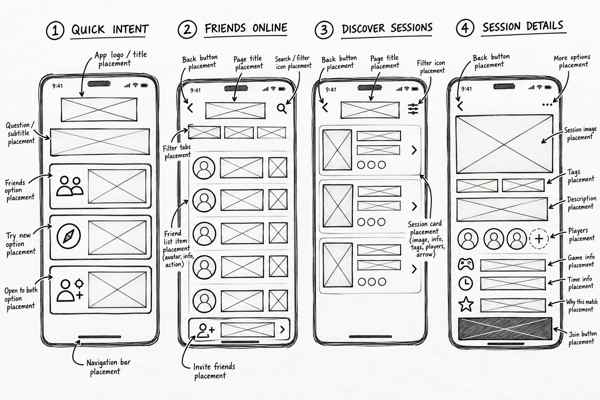
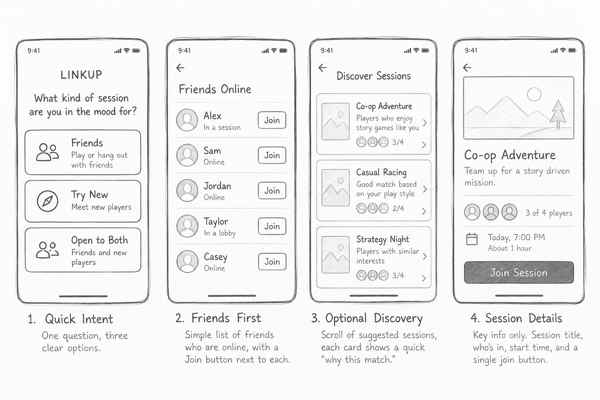
The annotation pass identifies the decisions; the pencil sketch presents the flow with fewer annotations.
05_LINKUP_Final_Black_Annotation_Pass(1).jpg
01_LINKUP_Initial_Pencil_Wireframes(1).jpg
01 Annotation pass: clarify hierarchy and movement.
02 Pencil sketch: a cleaner view of the four-screen flow.
LINKUP / Independent concept for Sony Interactive Entertainment
11
sony.pngplaystation.png
PORTFOLIO / SIE
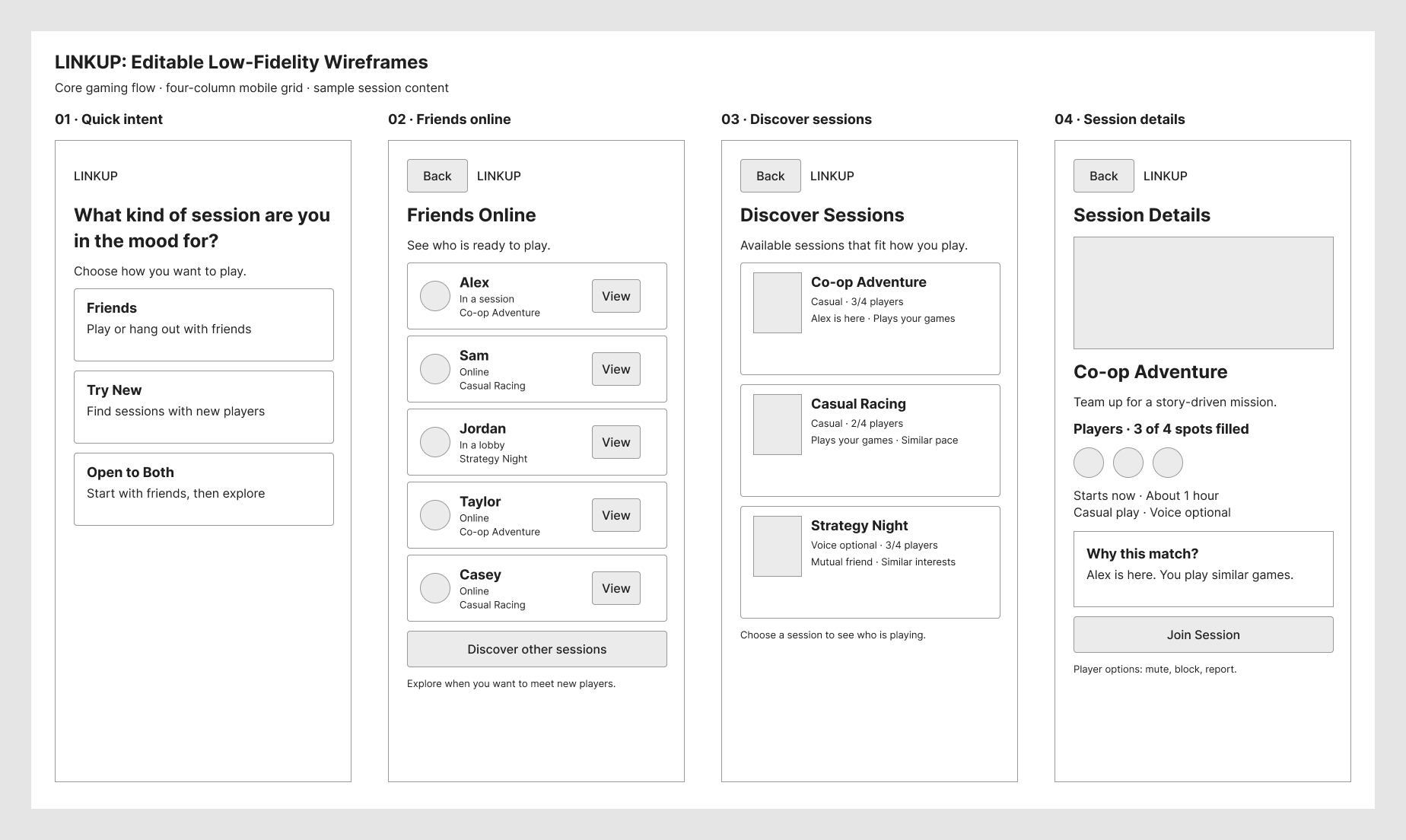
10 / DIGITAL WIREFRAMES
Turn the rough flow into a testable sequence.
Low-fidelity iterations focused on navigation, session fit, and the point of commitment.
wireframes_v1.png
WHAT WAS TESTED
Intent labels.
Friends versus new
players.
Session fit.
The joining action.
Editable screens made these
decisions reviewable before
final styling.
LINKUP / Independent concept for Sony Interactive Entertainment
12
sony.pngplaystation.png
PORTFOLIO / SIE
11 / EARLIER USABILITY SIMULATION
The first round exposed clarity problems.
Five fictional profiles completed five assigned tasks. All results and timings were invented.
SIMULATED RESEARCH / Fictional participants and assigned outcomes. No real study data.
Task
Unaided
Assisted
Assigned median
Find a friend
4 / 5
1 / 5
36 seconds
Explore new players
3 / 5
2 / 5
42 seconds
Evaluate session fit
2 / 5
3 / 5
76 seconds
Return to sessions
4 / 5
1 / 5
15 seconds
Join a session
3 / 5
2 / 5
28 seconds
16 of 25 attempts were assigned unaided completion. Session fit was the main design hypothesis to address;
these numbers do not measure product usability.
LINKUP / Independent concept for Sony Interactive Entertainment
13
sony.pngplaystation.png
PORTFOLIO / SIE
12 / ITERATION DECISIONS
Replace ambiguity with visible expectations.
Changes connect the earlier simulation to the later wireframes and high-fidelity design.
Earlier ambiguity
Design response
Reason
“Try New” / “Open Both”
Find new players / Friends + new players
Explain the social choice
Unclear fit before joining
Duration, voice, capacity, host context
Support a decision before commitment
Game and session titles overlap
Separate game identity and session naming
Reduce interpretation effort
Viewing could imply joining
View session, then Join session
Make commitment explicit
Joined means “already playing”
Reserved, invited, accepted, console next
Clarify each status
Failure could duplicate a request
Check status before retrying
Handle an unconfirmed join honestly
A later low-fidelity simulation assigned 22/25 unaided attempts. This was a revised scenario assumption, not validated improvement.
LINKUP / Independent concept for Sony Interactive Entertainment
14
sony.pngplaystation.png
PORTFOLIO / SIE
13 / VISUAL AND BRAND DIRECTION
A PlayStation-oriented presentation of LINKUP.
Sony and PlayStation identity frames the case study; LINKUP remains an independent product concept.
LINKUP
Cool neutrals, clear blue actions, and
restrained surfaces keep game imagery and
session information in focus.
Deep navy
Action blue
Soft surface
Quiet boundary
Interaction foundations
Inter in the source design. Main controls: 48 px. Back,
close, and navigation targets: 44 x 44 px. Focus stroke: 2
px. Corners: 8 px controls / 12 px cards. Shared light and
dark foundations.
Brand marks retain their original proportions. The
prototype uses game artwork to support
recognition; it does not imply a Sony partnership or
licensed product.
LINKUP / Independent concept for Sony Interactive Entertainment
15
sony.pngplaystation.png
PORTFOLIO / SIE
14 / FINAL MOBILE EXPERIENCE
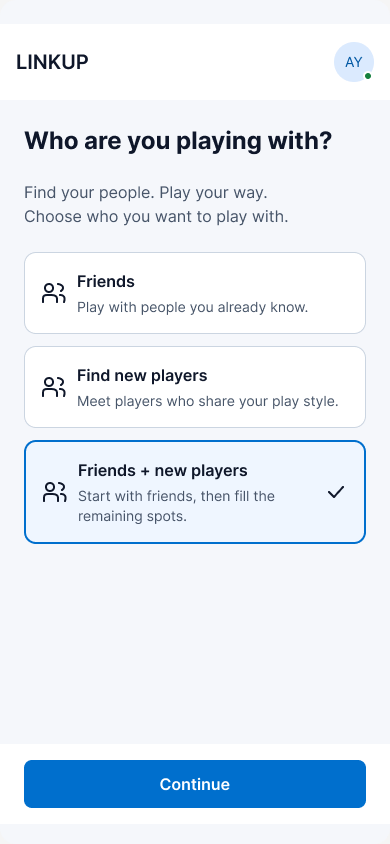
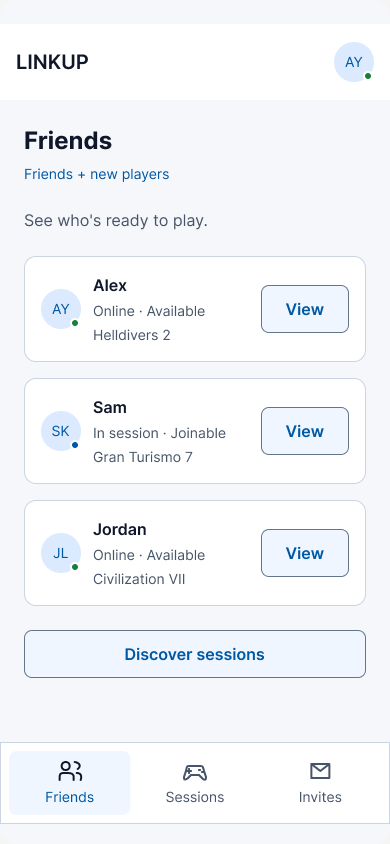
Intent first. Session fit next.
The core mobile journey moves from social preference to a concrete session decision.
intent.png
01 Choose who to play with
friends.png
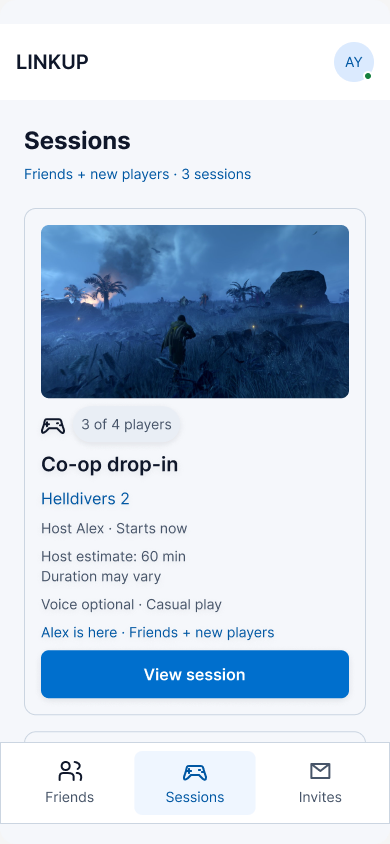
02 See familiar players
screen_0.png
03 Compare available sessions
screen_1.png
04 Review before joining
LINKUP / Independent concept for Sony Interactive Entertainment
16
sony.pngplaystation.png
PORTFOLIO / SIE
15 / SESSION EVALUATION
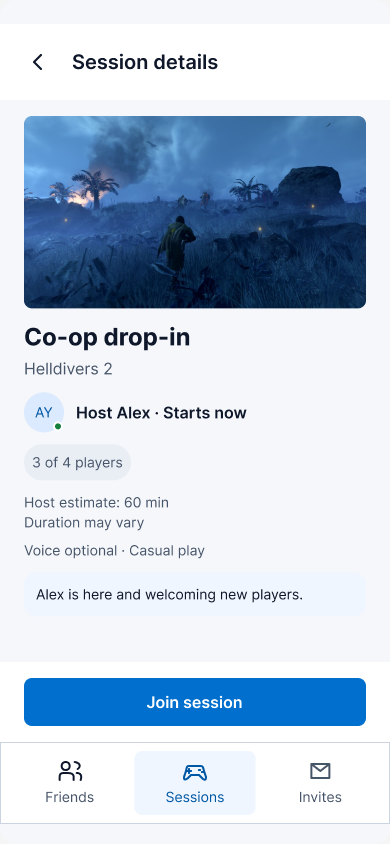
Give players a reason to say yes.
The session details surface information that helps players judge compatibility before joining.
screen_1.png
Recognize the game
Game identity and artwork anchor the session, alongside the host and
current player count.
Set realistic expectations
“Host estimate 60 min” and “Duration may vary” avoid presenting an
estimate as a guarantee.
Keep social comfort visible
“Voice optional” and “Casual play” help players judge the group before the
Join session action.
LINKUP / Independent concept for Sony Interactive Entertainment
17
sony.pngplaystation.png
PORTFOLIO / SIE
16 / INVITATIONS AND HANDOFF
Joining the session is one step toward playing.
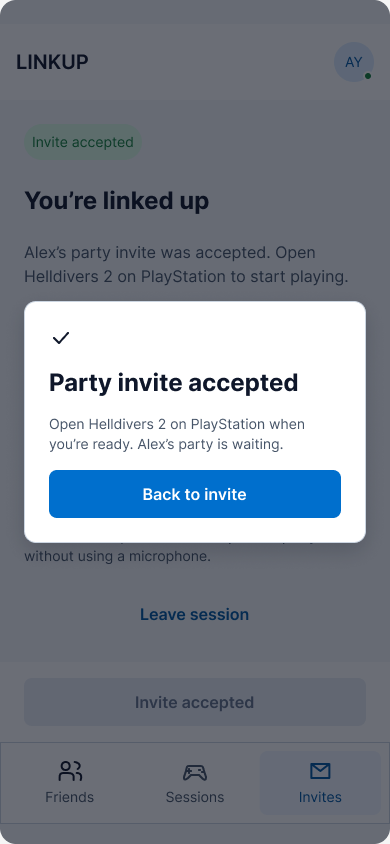
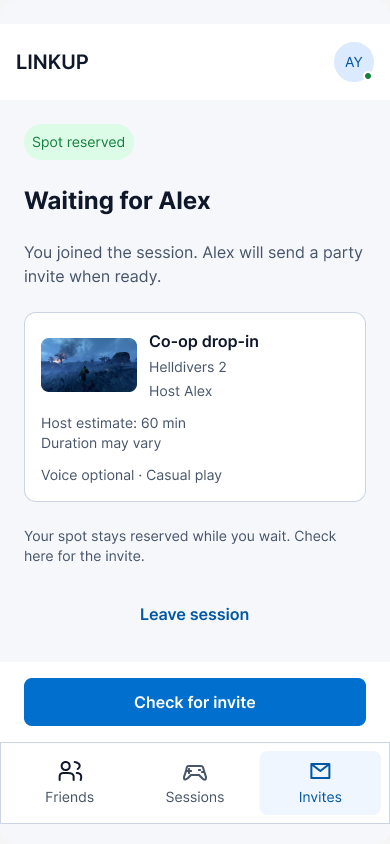
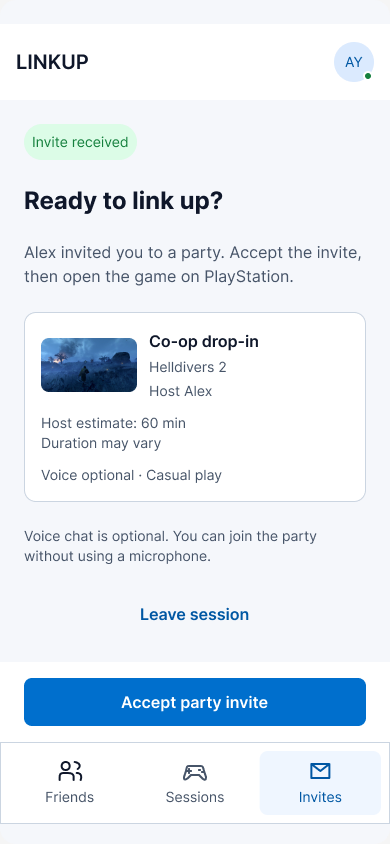
The prototype separates reservation, party invitation, acceptance, and opening the game on PlayStation.
waiting.png
Spot reserved / waiting for
host
received.png
Party invitation received
screen_2.png
Invitation accepted
The accepted
state explicitly
asks the player to
open the game on
PlayStation.
No automatic console
launch or live Sony
account integration is
implemented in this
concept.
LINKUP / Independent concept for Sony Interactive Entertainment
18
sony.pngplaystation.png
PORTFOLIO / SIE
17 / RESPONSIVE DESIGN
Keep the same decision hierarchy across sizes.
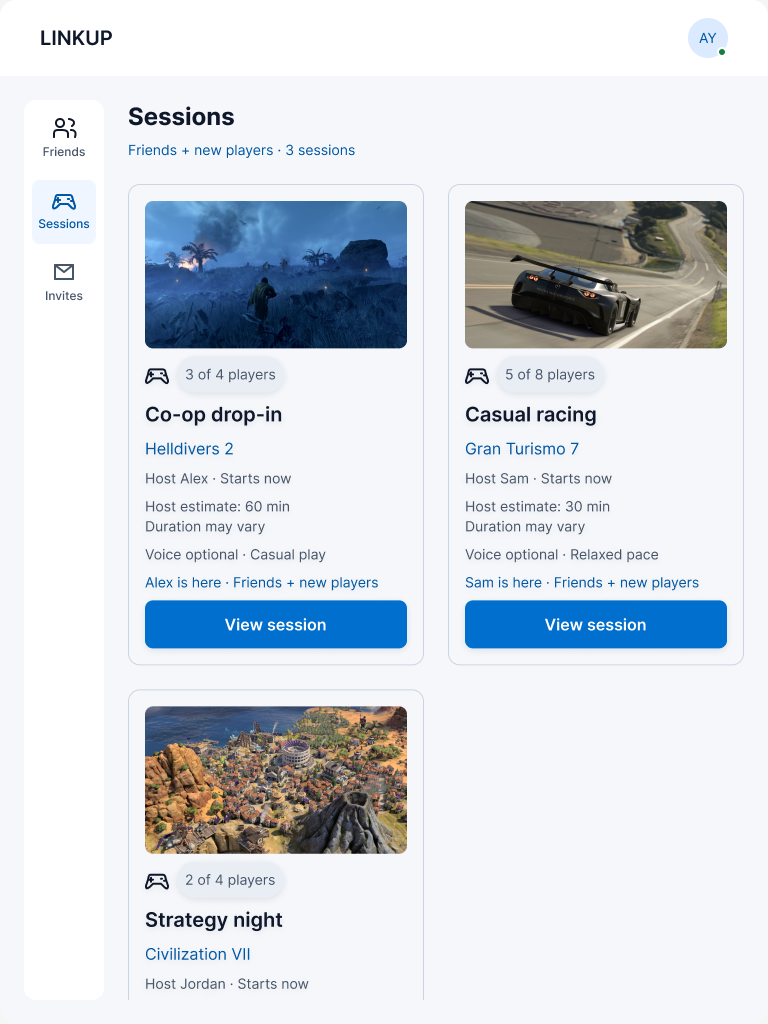
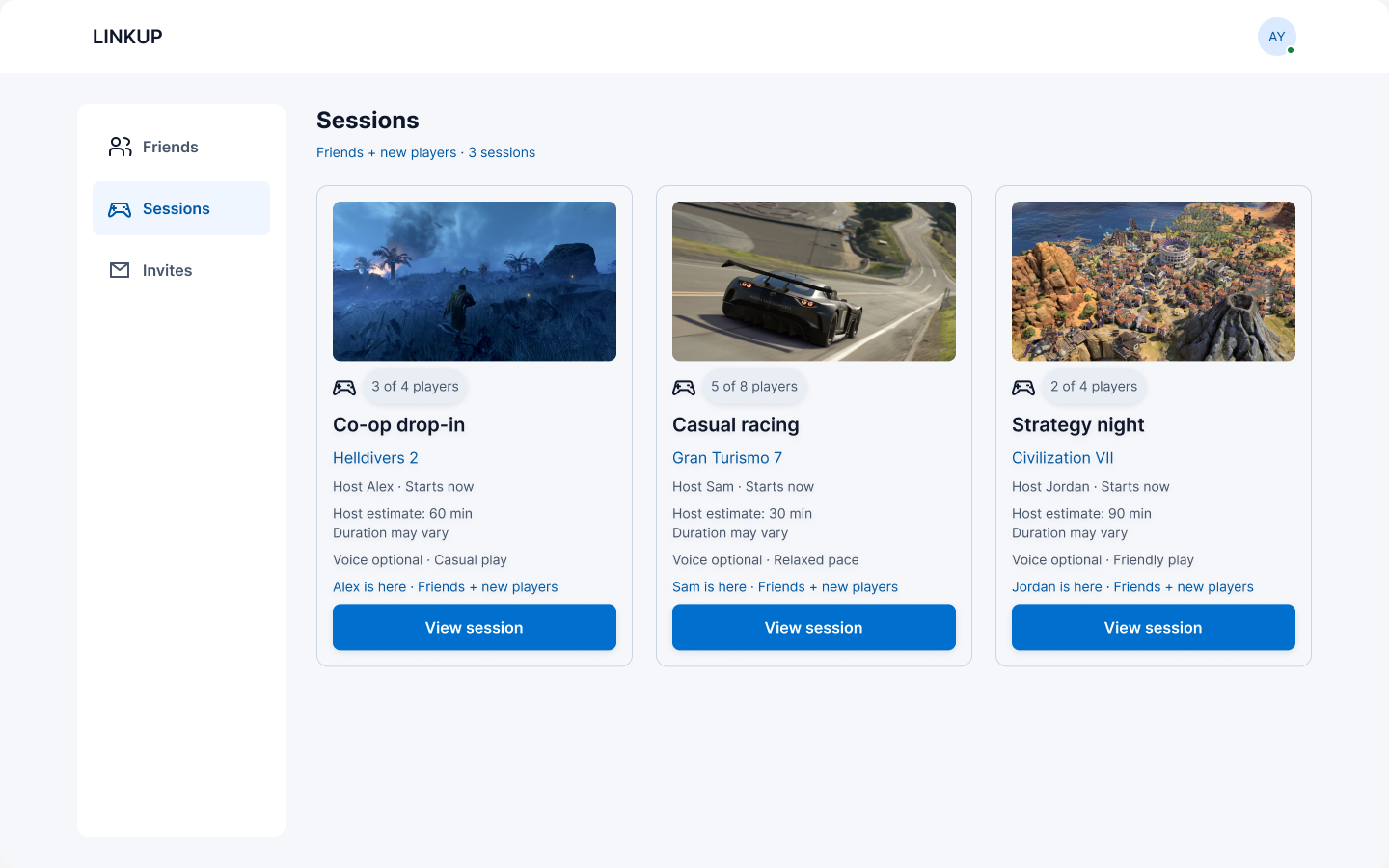
Mobile is the primary journey. Tablet and desktop explore wider information layouts.
tablet.png
screen_4.png
Tablet 768 x 1024
80 px rail; two card columns.
Desktop 1440 x 900
1280 px workspace; 216 px sidebar; three card columns.
LINKUP / Independent concept for Sony Interactive Entertainment
19
sony.pngplaystation.png
PORTFOLIO / SIE
18 / RECOVERY AND EXIT
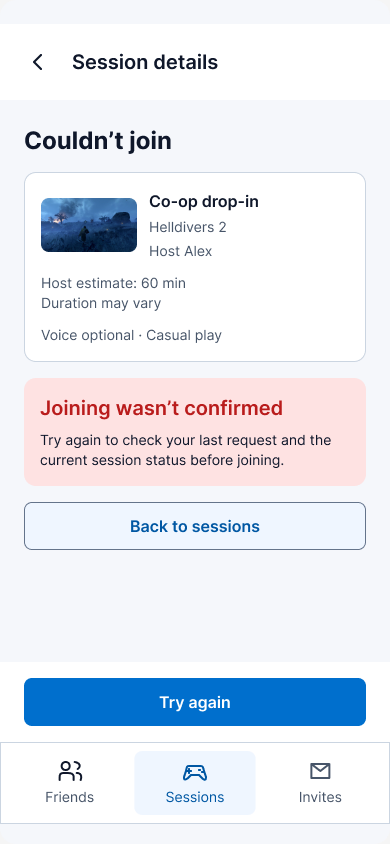
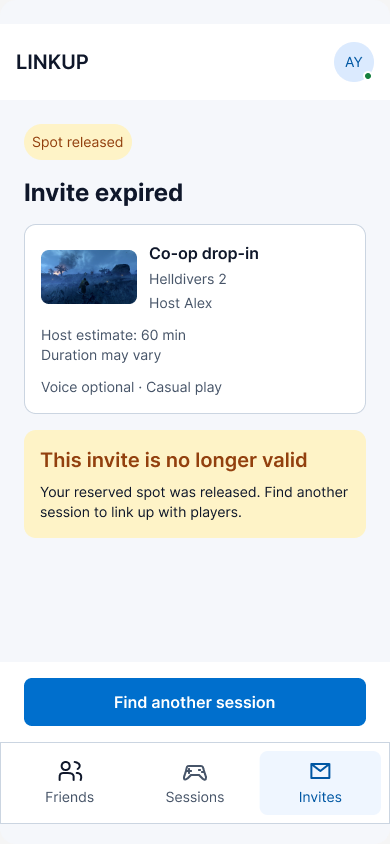
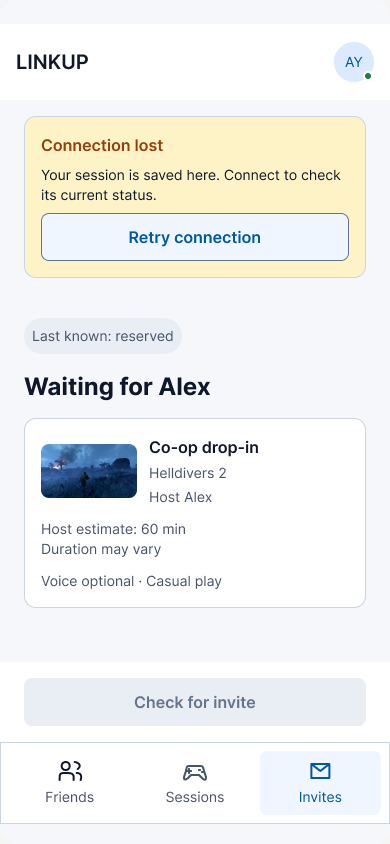
Keep the status truthful when things go wrong.
Failures need to explain what is known, what is uncertain, and what the player can do next.
screen_3.png
Unconfirmed join: retry
checks the request and
session status.
expired.png
Expired invitation: explain
why acceptance is
unavailable.
connection_lost.png
Lost connection: reconnect
and refresh the current
status.
Exit is a real action
Stay preserves the
spot. A confirmed leave
releases it and returns
to Sessions.
Dismissing pending UI
is not treated as proof
that a request was
cancelled.
LINKUP / Independent concept for Sony Interactive Entertainment
20
sony.pngplaystation.png
PORTFOLIO / SIE
19 / ACCESSIBILITY INTENT
Make interaction states understandable and operable.
These are design requirements and stress scenarios, not verified accessibility conformance.
Perception
Essential text targets 4.5:1 contrast;
meaningful icons and focus
boundaries target 3:1.
Use words as well as color for
status.
Check 320 px width, 200% text,
long names, and image fallbacks.
Operation
44 x 44 px targets for icon
navigation; 48 px primary controls.
Visible 2 px focus indicator.
Modal focus trap, restored trigger
focus, and Escape for unsubmitted
actions.
Verification still needed
Keyboard and screen-reader
behavior in an implemented app.
Real text scaling and device testing.
Reduced motion and announcement
timing.
Contrast measurements on final
assets.
LINKUP / Independent concept for Sony Interactive Entertainment
21
sony.pngplaystation.png
PORTFOLIO / SIE
20 / HIGH-FIDELITY EVALUATION
Six fictional profiles. Seven complete tasks.
The latest simulation covers comprehension from discovery through recovery and confirmed exit.
SIMULATED RESEARCH / Fictional participants and assigned outcomes. No real study data.
Profiles
P1 Experienced co-op player / mobile
P2 Time-limited casual player / mobile
P3 Competitive console regular / desktop
P4 Multiplayer newcomer / mobile
P5 Player without a microphone / mobile
P6 Larger-text preference / tablet
Tasks
T1 Choose intent and evaluate a session
T2 Join and understand the reserved spot
T3 Handle a delayed party invitation
T4 Accept and continue on PlayStation
T5 Recover an unconfirmed join
T6 Recover a lost connection
T7 Cancel or confirm leaving
LINKUP / Independent concept for Sony Interactive Entertainment
22
sony.pngplaystation.png
PORTFOLIO / SIE
21 / SIMULATION DATA
The waiting and handoff states need the most attention.
Assigned outcomes: U = unaided, no hesitation; H = unaided, hesitation; P = hypothetical prompt.
SIMULATED RESEARCH / Fictional participants and assigned outcomes. No real study data.
Task
P1
P2
P3
P4
P5
P6
T1
U
U
U
H
U
H
T2
U
H
H
H
U
H
T3
H
P
H
P
H
H
T4
U
H
U
P
H
H
T5
U
U
U
H
U
H
T6
U
H
U
U
U
H
T7
U
U
U
U
U
U
U
U
U
H
U
H
U
H
H
H
U
H
H
P
H
P
H
H
U
H
U
P
H
H
U
U
U
H
U
H
U
H
U
U
U
H
U
U
U
U
U
U
22 U / 17 H / 3 P
42 fictional task attempts.
Counts are assigned for critique;
they are not measured success
rates.
Separate engineering QA
The handoff reports 84/84
saved-route checks. This indicates
route checking, not user
comprehension; the original log
was not reviewed.
LINKUP / Independent concept for Sony Interactive Entertainment
23
sony.pngplaystation.png
PORTFOLIO / SIE
22 / WHAT TO IMPROVE NEXT
Make “what happens next” unmistakable.
Recommendations from the latest simulation remain proposals; they are not shown as completed fixes.
SIMULATED RESEARCH / Fictional participants and assigned outcomes. No real study data.
Priority / signal
Proposed revision
Validation question
P1 / T2-T3 hesitation
Elevate spot reserved + host next action
Can players explain the wait unaided?
P1 / T4 handoff prompt
Party invite accepted, then console next step
Do players know they must open the
game?
P2 / T1 scan hesitation
Keep game first; test larger text hierarchy
Can players identify fit while scanning?
P2 / T5-T6 recovery hesitation
Preserve status-check wording and leave path
Can players distinguish uncertain vs
reserved?
Explore automatic invite updates with a manual fallback. Avoid invented wait times or an “Open PlayStation” button without
a supported integration.
LINKUP / Independent concept for Sony Interactive Entertainment
24
sony.pngplaystation.png
PORTFOLIO / SIE
23 / FINAL PRODUCT AND REFLECTION
A coherent prototype with an honest next step.
The delivered design demonstrates product reasoning and interaction craft; market and usability validation remain open.
What the portfolio demonstrates
A behavioral persona model.
Research-to-design traceability.
Explicit commitment and handoff states.
Responsive layouts and recovery paths.
A shared visual and interaction system.
Why it is relevant to SIE
The concept focuses on starting play, social choice,
recognizable games, and continuity with console use.
It demonstrates attention to player trust and
accessibility expectations without claiming an official
integration.
Next: real player evidence
Recruit actual PlayStation players across the behavioral modes. Test fit, reservation, handoff, recovery, and
leaving without prompts. Then confirm demand, implementation feasibility, and accessibility on real devices.
LINKUP / Independent concept for Sony Interactive Entertainment
25
sony.pngplaystation.png
PORTFOLIO / SIE
24 / EXPLORE THE WORK
Open the prototype and inspect the evidence.
Source artifacts keep the design journey reviewable beyond this portfolio.
Open Mobile prototype
390 x 844 / primary journey
intent.png
Open Tablet prototype
768 x 1024 / wider layout
tablet.png
Open Desktop prototype
1440 x 900 / workspace
screen_4.png
Design foundations
UI foundations in the current file
FigJam: consolidated study
Scenario synthesis and task coverage
FigJam: portfolio assembly
Case-study narrative and supporting research
FigJam: latest simulation
Six profiles, seven tasks, and next revisions
LINKUP / Independent concept for Sony Interactive Entertainment
26
sony.pngplaystation.png
PORTFOLIO / SIE
25 / PROVENANCE AND SCOPE
Independent concept. Transparent evidence.
The case study uses Sony and PlayStation identity as its intended audience and ecosystem context.
All personas, interview summaries, usability profiles, quotations, timings, and task outcomes are
synthetic. They support design exploration and do not establish real user behavior, product demand,
or validated improvement.
Current screens are captured from the LINKUP Figma prototype. The latest simulation recommendations are kept
separate from the current prototype states. The 84/84 route-check statement comes from the project handoff, without
its original log.
REFERENCE LINKS
PlayStation App / ecosystem context
PlayStation hiring process / portfolio context
PlayStation accessibility
Sony Interactive Entertainment trademarks
Sony / PlayStation original logo files
Sony and PlayStation names and marks belong to their respective
owners. Game imagery appears in the concept prototype for
identification. This portfolio is not endorsed by or affiliated with
Sony Interactive Entertainment.
Sony wordmark source
LINKUP / Independent concept for Sony Interactive Entertainment
27